
In project management, a lot of attention goes into creating a solid estimate. But once the project moves forward, that estimate alone is no longer enough. What matters is whether your project is still performing as planned. And that’s where the cost baseline comes in.
In this blog, we explain what a cost baseline is, how to develop one, and how to use it effectively in project controls.

What Is a cost baseline in project management?
A cost baseline is the approved, time-phased budget used to measure and monitor project cost performance.
Instead of looking only at the total budget, the cost baseline shows how costs are planned to be incurred over time. This allows you to compare planned value with actual cost throughout the project.
In simple terms:
- The project budget defines the total approved funding
- The cost baseline defines when and where that budget is expected to be used
Without a cost baseline, you may know your total cost to date, but you lack the context to determine whether your project is on track.
Cost baseline components
A cost baseline is built from several structured components that connect scope, schedule, and cost.
At its core, it is derived from the work breakdown structure (WBS), where costs are estimated at the work package level and then aggregated into higher-level control accounts.
Typically, it includes:
- Work package costs: detailed cost estimates for the lowest level of work, including labor, materials, and equipment
- Direct costs: resources directly tied to project activities, such as labor hours, materials, and equipment usage
- Indirect costs: overhead and support functions that are not directly linked to a single activity
- Time-phased cost distribution: allocation of costs across the project schedule based on when work is performed
- Control accounts: integration points where scope, schedule, and cost are combined for performance measurement
- Contingency reserves: allowances for identified risks and uncertainties
Costs are first defined at a detailed level and then rolled up into the overall cost baseline.
The key is that all cost elements are linked to planned activities over time, which enables meaningful performance measurement and reliable cost control.
What is the difference between the cost baseline and the project budget?
Although often confused, the cost baseline and the project budget serve different purposes.
The project budget represents the total approved funding for the project, while the cost baseline is the time-phased version of that budget used to track cost performance over time.
In practice:
- The budget is used for funding and approvals
- The cost baseline is used for monitoring and control
There is also a difference in how reserves are treated:
- Contingency reserves and management reserves are excluded and held separately
In a nutshell:
Project budget = cost baseline + contingency + management reserve
Benefits of using a cost baseline in project controls
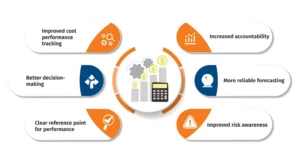
A well-developed cost baseline provides several practical benefits for project control and decision-making:
- Improved cost performance tracking: By comparing planned value with actual cost, you can quickly identify variances and assess whether the project is on track.
- Better decision-making: Early insight into cost performance allows project teams to take corrective action before deviations escalate.
- Clear reference point for performance: The cost baseline serves as the benchmark against which all cost performance is measured throughout the project lifecycle.
- Increased accountability: Costs are linked to specific work packages and control accounts, making it easier to identify where deviations occur.
- More reliable forecasting: Performance trends against the baseline support more accurate forecasts (e.g., the estimate at completion).
- Improved risk awareness: By incorporating contingency reserves and tracking deviations, the baseline helps identify financial risks early and supports more informed risk responses.
How to create a cost baseline
Developing a cost baseline integrates scope, schedule, and cost into a single control framework.
The process typically follows a logical sequence:
- Define the project scope
Start with a clear understanding of what needs to be delivered. Use a well-structured work breakdown structure (WBS) to define the work packages where costs will be assigned and managed. - Develop the project schedule
Once the scope is defined, translate it into a realistic schedule. Activities, durations, and dependencies determine when work will take place and thus, when costs will occur. - Estimate costs at the work package level
Costs are developed in detail, typically at the lowest level of the WBS. This includes labor, materials, equipment, and any subcontracted work. The more structured this step is, the more reliable the baseline will be. - Aggregate and structure the costs
Individual estimates are then rolled up into control accounts and higher-level cost structures. This creates a clear link between detailed estimates and overall project cost control. - Assign costs to the schedule (time-phasing)
Next, the costs are distributed over time based on the planned execution of work. This step turns a static estimate into a cost baseline for performance tracking. - Include contingency reserves
Contingency budgets are added for identified risks. Without this step, even well-prepared estimates tend to fall short once the project is underway. - Review and approve the baseline
Before it becomes the project’s reference point, the baseline is reviewed and aligned with key stakeholders. Once approved, it serves as the foundation for cost performance measurement.
The result is a time-phased cost baseline that reflects how the project is expected to progress. From that moment on, it becomes the reference for tracking actual costs, identifying deviations, and supporting ongoing project control.
A cost baseline example
Consider a project with a total budget of €100,000 over four months.
Instead of treating this as a single amount, the cost baseline distributes the costs over time:
- Month 1: €20,000
- Month 2: €30,000
- Month 3: €30,000
- Month 4: €20,000
This distribution reflects the planned execution of work.
If, after two months, the actual cost to date is €70,000 while the planned value is €50,000, the project shows a cost overrun at that point in time.
This is exactly what the cost baseline is designed for: providing context for performance evaluation.
Common cost baseline mistakes that lead to poor cost control
Even well-prepared baselines can fail if certain pitfalls are not addressed.
- Treating the baseline as fixed and ignoring changes: Projects evolve. Changes should be managed through formal change control.
- Weak integration between cost and schedule: If costs are not aligned with activities, performance measurement becomes unreliable.
- Insufficient contingency planning: Underestimating risks leads to unrealistic baselines and frequent cost overruns.
- Lack of detail in the baseline: A high-level baseline makes it difficult to identify the source of deviations.
- No clear ownership of cost control: Deviations aren’t actively managed without accountability.
Avoiding these issues significantly improves the effectiveness of your cost baseline.
How to manage and control the cost baseline
Once approved, the cost baseline becomes the reference point for measuring project cost performance.
Managing it is an ongoing process throughout the project. As work progresses, actual costs are recorded and compared against the baseline to assess whether the project is on track.
Effective cost control typically involves:
- Tracking actual costs against the baseline
- Measuring and interpreting cost variances
- Investigating the root causes of deviations
- Updating forecasts, such as the estimate at completion (EAC)
- Taking corrective actions where needed
The cost baseline is not adjusted lightly. Changes are only made through formal change control, typically when there are significant scope or schedule changes.
In practice, the baseline acts as a stable reference point. It allows project teams to detect issues early, understand their impact, and respond in a structured way.
A well-managed cost baseline turns cost data into insight and better decisions.
How Cleopatra Enterprise can help manage cost baselines
Managing cost baselines in spreadsheets can quickly become complex, especially in large-scale projects with many stakeholders and thousands of cost elements.
Solutions like Cleopatra Enterprise’s project controls software support a more structured approach by integrating cost estimates, schedules, and performance tracking in a single environment.
This allows project teams to maintain a reliable cost baseline, improve visibility into cost performance, and make more informed decisions throughout the project lifecycle.
Controlling costs remains one of the toughest challenges in construction projects. Without clear insight into when and where…
Most projects do not run into budget overruns overnight. There are several warning signs long before overruns occur,…
FAQs
-
Is contingency reserve included in the cost baseline?
Yes, contingency reserve is typically included in the cost baseline, as it covers identified risks. Management reserves are excluded.
-
How does the S-curve relate to the cost baseline?
The cost baseline is often visualized as an S-curve, showing cumulative planned value over time and enabling comparison with actual cost.
-
What is the difference between a cost baseline and a cost forecast?
The cost baseline represents the approved plan, while a cost forecast reflects the expected final cost based on current performance.
-
What happens when actual costs exceed the baseline?
This indicates a cost overrun. The project team should analyze the variance, identify root causes, and take corrective action or update forecasts.
-
How often should a cost baseline be updated?
The cost baseline should only be updated through formal change control processes, not on a routine basis.
-
When should you revise the cost baseline?
Cost baseline revisions are typically required when approved scope changes, significant deviations, or major changes in project conditions occur.
Related resources

Cleopatra Cost Management: Tight integration with Primavera P6
Cleopatra Enterprise offers an out-of-the-box integration with scheduling software Oracle Primavera to bring your cost management to the next level.
Read blog article
The Impact of Inflation on Construction Project Budgets
Inflation is a factor that can quietly erode project budgets long before anyone realizes it. In construction and other capital-intensive industries, where timelines often stretch into years, even a small annual price increase can compound into major cost overruns over time. As project managers, cost estimators, and controls professionals, understanding…
Read blog article