

When engineering, procurement, and construction teams operate from different systems, or worse, different spreadsheets, schedule and budget overruns tend to follow. Using EPC project management software can prevent that fragmentation by integrating cost, schedule, commitments, and performance data in a single environment.
This guide walks through what separates purpose-built EPC software from generic tools, what features matter, and how to make a tool decision you won’t regret six months into a project.
What makes EPC projects uniquely hard to manage
EPC projects combine three disciplines that operate at different speeds.
Engineering works in revisions and design iterations. Procurement deals with suppliers, contracts, and lead times. Construction teams focus on field execution and daily productivity.
Each phase influences the others. For example, a delay in engineering pushes out procurement, and a late material delivery stalls construction. By the time the ripple effect shows up in a status report, you might have already lost weeks.
A few realities make EPC management demanding:
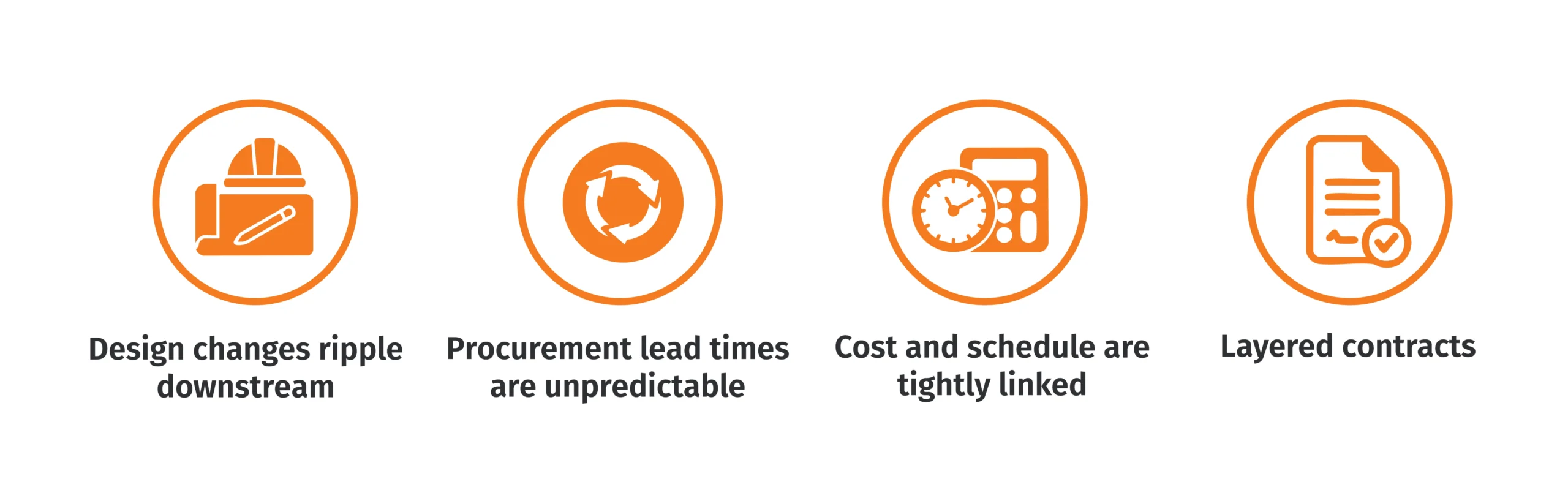
- Design changes ripple downstream: A late engineering revision can invalidate purchase orders or delay site activities.
- Procurement lead times are unpredictable: Long-lead equipment affects critical path milestones.
- Cost and schedule are tightly linked: A delay often increases indirect costs, site overhead, and contractor claims.
- Layered contracts: Subcontractors, vendors, and joint ventures create financial and legal exposure.
When separate systems track these interdependencies, it is easy to miss early warning signals. EPC environments require integrated visibility across engineering, procurement, cost, and schedule. Without that integration, control quickly turns into reaction.
EPC project management software vs ERP: what’s the difference?
Many organizations ask whether an ERP system can handle EPC management. ERP systems manage company-wide finance, HR, and procurement. EPC project management software focuses on project controls and execution.
Here’s a practical breakdown:
| Criteria | EPC project management software | ERP System |
|---|---|---|
| Primary focus | Project-level cost, schedule, scope, and performance control | Organization-wide financial and operational management |
| Cost Control | Supports budget baselines, forecasting, and earned value | Tracks accounting transactions and actual costs |
| Schedule Integration | Links cost and schedule for performance analysis | Usually limited or requires external scheduling tools |
| Engineering integration | Manages revisions, documents, and change impact | Limited engineering-specific functionality |
| Procurement tracking | Connects POs to project milestones and forecasts | Handles purchasing and vendor payments |
| Use case | Capital projects and megaprojects | Enterprise resource planning across departments |
In practice, ERP systems are essential for financial governance. They are not designed to provide real-time project performance forecasting. Many mature organizations integrate their ERP with a dedicated EPC project controls platform to gain both financial accuracy and operational visibility.
The core features that matter in project management software for EPC
Here are the core features to look for and how they address EPC pain points.
Project planning & scheduling
Robust planning tools such as work breakdown structures (WBS), milestone tracking, and baseline schedules help teams structure engineering, procurement, and construction activities across the full project lifecycle.
Using clear schedules makes it easier to identify delays early and prevent downstream disruptions.
Integrated cost control
The solution should support the full cost lifecycle, from estimates and budgets to commitments, actual costs, and forecasts.
Connecting cost data to project progress enables quick detection of overruns.
Procurement tracking
Procurement often drives the critical path, especially when long-lead equipment is involved.
Linking purchase orders, supplier timelines, and delivery milestones to project activities helps teams identify risks before material delays impact construction.
Engineering document control
EPC projects generate thousands of drawings, specifications, and technical documents.
Centralized document control ensures version tracking, approval workflows, and access to the latest revisions across engineering and construction teams.
Change management
Scope changes will happen. Structured change management allows teams to track variations, assess cost and schedule impact, and update project baselines accordingly.
Field progress tracking
Construction progress should be measured through tangible outputs instead of percentage estimates. Field teams can report updates directly from mobile devices, so progress feeds automatically into schedules and cost reports. There is no need to wait for office reconciliation.
Dashboards and project analytics
Real-time dashboards provide visibility into budgets, schedules, risks, and performance metrics across projects.
Integration with enterprise systems
EPC platforms should integrate with ERP systems, financial tools, BIM platforms, and other enterprise software.
Integration reduces data silos and ensures engineering, procurement, construction, and financial teams work from the same information.
Benefits of implementing EPC software
Common benefits for EPCs when implementing project management software include:
- Faster more informed decisions: Real-time data and dashboards give managers visibility across costs, schedules, and risks.
- Reduced surprises: Early detection of deviations prevents last-minute budget or schedule crises.
- Less firefighting: Teams spend time solving problems instead of chasing updates from spreadsheets and emails.
- Better team coordination: Engineering, procurement, and construction work from the same data, reducing miscommunication and rework.
- Improved resource use: Optimize staff, equipment, and material allocation to avoid bottlenecks and idle time.
- Stronger compliance: Centralized documentation and audit trails simplify adherence to contracts, safety standards, and regulatory requirements.
- Field-ready operations: Mobile access allows field teams to report progress in real time, keeping data accurate and current.
Taken together, these benefits enable EPCs to run projects with greater predictability and efficiency, turning complexity into control.
How to evaluate EPC project management software: a practical framework
To choose the right project management software for EPC, assess how well a platform supports your cost control, scheduling, procurement, and reporting workflows.
Step 1: Map your current processes
Document how you handle budgets, forecasts, procurement, schedule updates, and change orders. Identify gaps and workarounds. These indicate where software must deliver value.
Step 2: Assess your integration needs
Determine whether integration is needed with ERP systems, scheduling tools, document management platforms, or BI dashboards.
Step 3: Assess forecasting and analytics capabilities
Evaluate capabilities such as CPI/SPI calculations, Estimate at Completion forecasts, scenario modeling, and historical benchmarking.
Step 5: Evaluate scalability and governance
For larger EPC projects, the software should support multi-project oversight, role-based access, audit trails, and strong data security. Make sure it can handle complex workflows and maintain control across multiple teams.
Step 6: Run a pilot
Test the software on a live project or partial workflow. Pilots reveal workflow gaps and usability issues that demos cannot.
Step 7: Involve project controls professionals
Cost engineers, schedulers, and project controllers must evaluate the system against real workflows. Tools chosen without their input often fail when the project is underway.
How Cleopatra’s software streamlines EPC management
Cleopatra Enterprise is a capital project management software built for EPC and other capital-intensive industries. Unlike generic project management tools, it connects cost estimating, cost control, and performance monitoring in a single platform, giving teams one source of truth.
For EPC organizations, this means:
- Integrated cost and schedule control aligned with Earned Value principles.
- Real-time forecasting and analytics for CPI, SPI, and Estimate at Completion.
- Structured change management with a full audit trail.
- Multi-project oversight across capital programs and turnarounds.
- Estimating and historical benchmarking to reuse past data.
- Seamless integration with Primavera P6, ERP systems, and other enterprise tools.
With all data live and centralized, your project controls team spends time analyzing performance, not reconciling spreadsheets.
Controlling costs remains one of the toughest challenges in construction projects. Without clear insight into when and where…
Most projects do not run into budget overruns overnight. There are several warning signs long before overruns occur,…
FAQs
-
Can ERP systems replace EPC project management software?
ERP systems handle company-wide financial management, procurement, and accounting. However, they typically lack project control capabilities such as integrated scheduling, earned value analysis, progress measurement, and engineering document workflows. For this reason, many EPC organizations integrate ERP systems with specialized software.
-
What features are most important in EPC project management software?
The most critical capabilities typically include:
- integrated cost and schedule control
- procurement tracking
- document management
- change management
- field progress tracking
- real-time project analytics
Related resources

Cleopatra Cost Management: Tight integration with Primavera P6
Cleopatra Enterprise offers an out-of-the-box integration with scheduling software Oracle Primavera to bring your cost management to the next level.
Read blog article
The Impact of Inflation on Construction Project Budgets
Inflation is a factor that can quietly erode project budgets long before anyone realizes it. In construction and other capital-intensive industries, where timelines often stretch into years, even a small annual price increase can compound into major cost overruns over time. As project managers, cost estimators, and controls professionals, understanding…
Read blog article